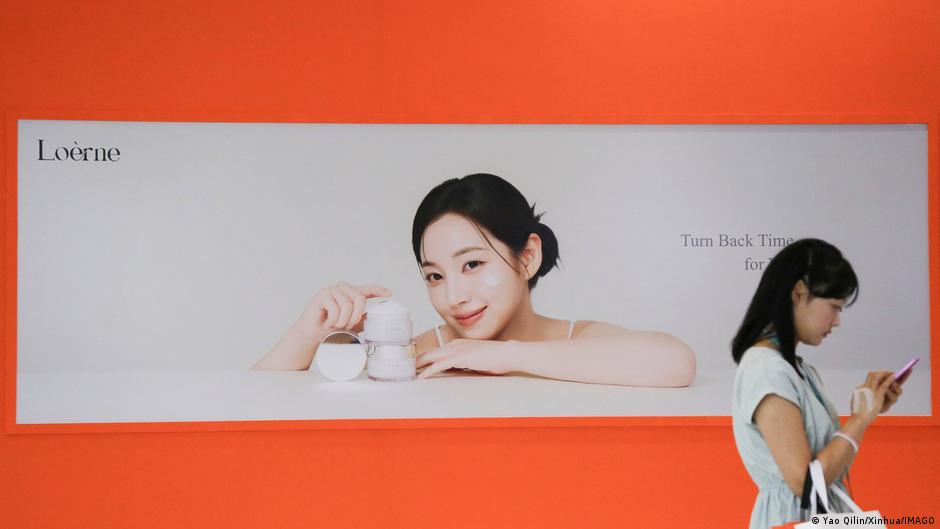
First it was cars and electronics, then pop music and movies, and now the beauty industry. “Made in Korea” skin care and cosmetics are in demand all over the world.
More and more Westerners are becoming enthusiastic about Korean beauty products. This success is no accident, nor is it a purely aesthetic phenomenon.
The East Asian country has made cultural exports an important source of soft power. What is known as “K-beauty” relies on a combination of cultural dynamics, economic strategy, and geopolitical positioning.
“Soft power means using charm rather than force to influence others,” explains Hannes Mosler, a political scientist and Korea expert at the University of Duisburg-Essen. This is extremely important for a country like South Korea, he says.
“South Korea is in a geopolitically unstable position between two major powers, which is why it is intentionally exploiting its cultural appeal.”
This strategy has proven so effective that “K-beauty” has now become a global phenomenon.
Seoul’s Yonhap News reported that cosmetics exports increased by 12.3% in 2025, reaching a total of $11.43 billion (9.84 billion euros).
According to South Korea’s Ministry of International Trade and Industry, the export value of cosmetics has already reached $10.2 billion in 2024.
Korea is trending
But their success cannot be explained by economic statistics alone. The close relationship between culture and consumption is decisive.
“Consumer trends reflect cultural trends,” said Stefan Tobel, CEO of Kenkana, a Hamburg-based company that specializes in importing and selling Korean cosmetics.
“Korea has become a big player on the world stage thanks to K-pop, and consumer trends have come with it.”
This observation is supported by market research.
According to a report by American market research firm Grand View Research, “The global rise of Korean pop culture, including K-pop and K-dramas, is playing an important role in expanding K-beauty around the world.” specializes in analyzing global consumer and technology markets.
Mosler goes one step further. “Hallyu is not purely government-orchestrated, but there was political support from a very early stage,” he says.
He explains that TV series, music and digital platforms all create a cultural infrastructure for products to be recognized around the world, meaning K-beauty is “part of South Korea’s broader image.”
Research Gate, an international research network that collects scientific research from around the world, points to research that suggests Korean popular culture is being intentionally deployed as a “nation branding” tool to enhance the country’s international image.
Consider instead of hiding
When it comes to K-Beauty, we have a unique understanding of skin care. “Korea’s approach is much more sophisticated,” Tobel explains. “Skin is not something to hide, it is something to improve.”
London-based international consulting firm Euromonitor International specializes in market analysis and consumer goods. One of those studies shows that Korean products have a strong focus on prevention, skin health, and long-term skin care.
Mosler believes this approach comes from Korean society. “Appearance plays a huge role,” he says.
He believes that an intensely competitive environment creates strong social pressures and, with it, a particularly demanding market. “For a product to work well, it has to perform to a very high standard,” he says.
Research supports this view. Grand View Research describes the K-beauty market as characterized by “rapid product innovation cycles to meet evolving consumer expectations.”
Tobel believes this dynamic is important in the field, saying, “Markets move very fast. New materials, new formats, new routines. Those who are not persistently innovating quickly lose relevance.”
Role of social media
“Social media plays a central role,” Tobel continues. Platforms like TikTok and Instagram act as accelerators where trends are created and broadcast around the world, and K-beauty is particularly good at this.
Mosler emphasizes the importance of cultural multipliers. “K-Pop stars and franchises create visibility and, with it, demand.”Beauty products become part of an overall aesthetic and cultural package.
From this, it is clear that K-beauty is not just a trend, but a system that combines culture, technology, marketing, and politics. “This is a question of attractiveness, both culturally and politically,” Mosler said.
This article has been translated from German.
#Beauty #strategy #Korean #beauty #political #success