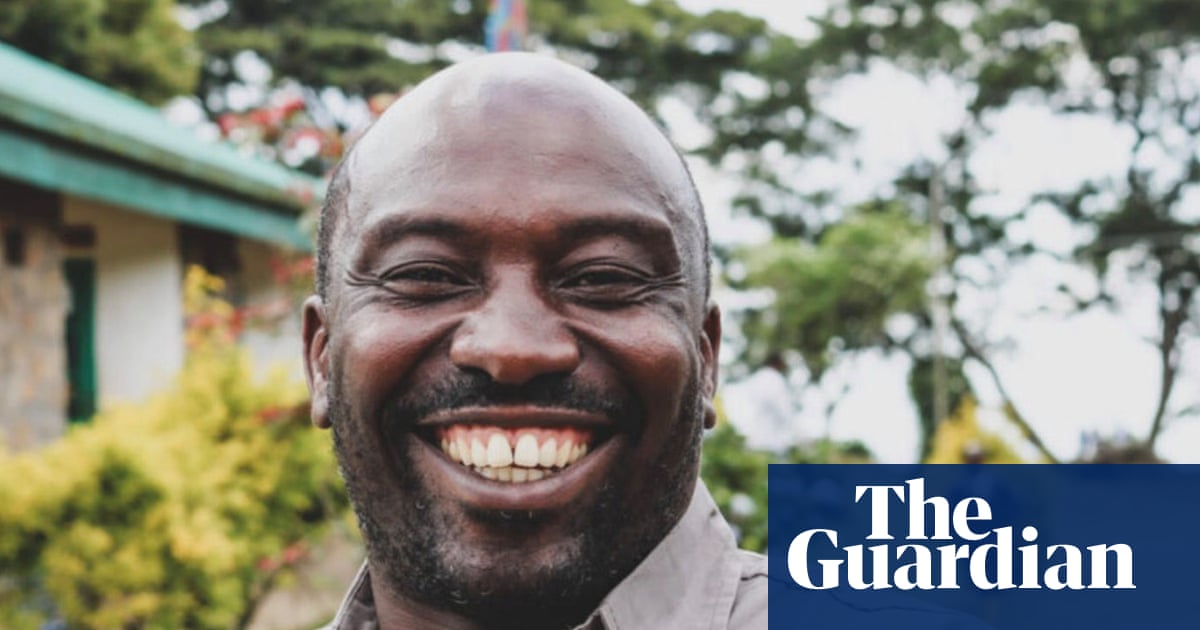
MThis gorilla hangs low on the forested slopes of Kahuzi-Biega National Park, whose canopy still protects one of the last bastions of the eastern lowland gorilla, or Grauer’s gorilla. It is a landscape of immense biological wealth and equally immense political vulnerability. For 54-year-old Dominic Bicaba, this was once home.
His family was among those displaced when their ancestral land was incorporated into a park in the 1970s. Located in the lowlands of South Kivu in the Democratic Republic of the Congo (DRC), this reserve is home to elephants and a variety of other wildlife, but is best known as the primary habitat for the Grauer gorilla, the largest subspecies of primate known to grow up to 250 kg (39th) in weight. It is one of five great ape species found in the vast forests of the Democratic Republic of Congo, including mountain gorillas, which also live in other parts of the Great Lakes region, such as Rwanda and Uganda.
For Bikaba, founder and executive director of Strong Roots Congo, conservation has always been linked to memory, dispossession, and survival.
He grew up on the fringes of the park, close enough that he remembers walking through the woods as a child. “My grandmother used to take me to the forest, where I could see how gorillas lived,” he recalls. His upbringing spans the world: along with his biological mother, he was raised by a Batwa (Pygmy) mother and grandmother. Much of his childhood was spent in the Batwa community, where cultural and spiritual life is deeply rooted in the forest.
From them he learned about medicinal plants, wild animals, and what coexistence means in practice. “My grandmother taught me how to be a man, but my pygmy mother taught me how to coexist with the forest,” he says.
At the time, the Grauer gorilla was not yet classified as an endangered species. Gorillas and humans shared space in a cautious yet comfortable balance. “Sometimes they would come out of the forest and eat our crops. The baboons would come for our bananas,” Bikaba says. It was an uneasy approach, but not yet a catastrophe. War would change that.
Bikaba began conservation work in 1992, at the age of 20, after completing his studies and responding to a call from community leaders to mediate tensions between park authorities and the people who had been displaced since the park’s opening. Two years later, the 1994 Rwandan genocide triggered a mass refugee influx into the eastern Democratic Republic of the Congo, sparking the First Congo War and then the Second Congo War in the late 1990s. The fighting continues today.
The impact on wildlife is devastating. Before the conflict, the eastern lowland gorilla population was estimated at approximately 17,000 individuals. By 2016, research suggested there were about 3,800 left. “We don’t know what kind of situation the gorillas are in now. Perhaps after the war we may be in a better position to observe them and see what happened,” Bicaba said.
An IUCN report published in 2016 highlighted that widespread slash-and-burn and bushmeat hunting are contributing to the population decline, and that the country’s ongoing conflict continues to exacerbate the problem.
Bikaba quietly talks about the circumstances that led to his near death. “I escaped death many times, but my friends and relatives were not so lucky.”
In 2009, he founded Strong Roots Congo with the aim of reconciling conservation and community rights around Kahuzi-Biega National Park. The organization worked in collaboration with the Congolese Institute for Conservation of Nature (ICCN) during renewed national efforts to protect forests. But Bikaba’s focus remained broad. “We wanted to go beyond these forests,” he says, explaining how the community itself pushed for stronger protections for gorillas and other species.
An expedition in late 2010 fleshed out a more ambitious vision: working with around 70 emirates (traditional local government units) outside the reserve to create a biodiversity corridor linking Kahuzi-Biega National Park and Itumbwe Nature Reserve. The aim was (and remains) to set aside 1 million hectares (2.47 acres) for wildlife and indigenous communities, reconnecting fragmented habitats while formally establishing customary land rights.
So far, Strong Roots has supported the establishment of 23 community forests, covering approximately 600,000 hectares. Through partnerships with international conservation organizations, we help communities transform customary tenure rights into legally recognized community forestry rights. This model reflects approaches being trialled in parts of Latin America, where indigenous management has proven compatible with forest protection.
“The important thing is that we also want to improve people’s lives,” says Bikaba. Conservation here sits at the intersection of ecology and geopolitics. The park is both a species sanctuary and the scene of a conflict that has smoldered for more than 30 years.
Anxiety complicates everything. “We’ve never really felt peace,” he says. After M23 rebels captured Goma, his office was looted and fighting sometimes made the site inaccessible. What used to be a 30-minute flight from Bukavu to Shabunda is now a four-day journey with multiple stops.
In addition to protecting other large mammals, the planned corridor will reconnect isolated gorilla populations and increase their chances of reproduction and recovery. Importantly, it is co-managed by forest and indigenous communities. Indigenous peoples’ relationship with forests predates colonial boundaries and modern conservation laws.
For Bikabar, who grew up on the edge of a forest and was shaped by displacement and tradition, this work brings a sense of redemption. “What we’re doing is bringing communities back together so they can thrive together, as they have for centuries,” he says.
He is wary of conservation models that view local people as a threat. “Western conservationists say indigenous peoples destroy forests because they are poor and tend to separate animals from humans,” he says. “But humans are also part of nature, and there is a lot of wisdom we can learn from communities living in the forest.”
As fighting continues in eastern DRC, the future of Grauer’s gorillas remains uncertain. For Bicaba, the lessons of the last 30 years are harsh. “If there’s one thing to avoid in life, it’s war,” he says. “If there is a way to stop the war in this region, we should do it, no matter the cost.”
Click here for more coverage on age of extinction. You can also follow biodiversity reporters Phoebe Weston and Patrick Greenfield on the Guardian app for more nature coverage.
#escaped #death #times #mans #lifelong #work #protecting #gorillas #communities #Congo