
Scientists have captured rare underwater footage of a whale giving birth, revealing a level of coordination and assistance from nearby whales that is rarely recorded in the wild. This video was recorded by the following team: marine scientistshowing not only the moment of birth, but also how other whales were nearby and appeared to be helping the mother in the process.
The center of the image is humpback whale During calving, she is surrounded by several other whales, maintaining a tight formation. When the calf emerges from its tail, this is the typical whale birthing position, but the surrounding whales stay close and move slowly and carefully.
A moment rarely observed in the open ocean
It is difficult to observe whale births in the wild. These usually occur in remote areas or deep ocean, and their timing is unpredictable. Most of our scientific understanding of whale reproduction comes from indirect observations and studies of stranded individuals. Direct and high quality picture It is extremely rare for a baby to give birth alive in its natural state.
In this case, researchers were already tracking a pod of whales when they noticed an unusual movement pattern. The whales began circling more closely, and one showed the following signs: labor. The team set up an underwater camera that clearly captured the calf’s appearance and the group’s immediate reaction.
As is often the case during birth, the calf initially appears motionless. But soon it begins to move, and the adult whale pushes it upwards. surface. This is an important step because newborn whales need to quickly reach the surface to take their first breath.
evidence of cooperative behavior
One of the most striking aspects of this footage is the presence of multiple whales surrounding the mother. Humpback whales are not typically considered to be highly social like some dolphin species, but they do form temporary groups, especially on breeding and feeding grounds.
In the recorded scene, at least four other whales remain close to the mother throughout the birth. Some sit slightly below or to the side of her, while others pivot outward to act as a buffer against potential threats. Researchers suggest that these whales may be escorts. This is a term used to describe an individual that accompanies its mother or animal. calf.
There is also evidence that one whale may have helped stabilize the newborn. After birth, as the calf drifts downward, the adult appears to move underneath and guide the calf upward. Although it is still unclear whether this is intentional assistance or instinctive positioning, this behavior is consistent with previous, more limited observations.
The first moments of a calf’s life
The video shows the calf making its first movements within seconds of birth. It begins to orient itself, following the upward movement prompted by nearby adults. Whales are air-breathing mammals and cannot survive long without reaching the surface, so reaching the surface is essential. oxygen.
Once on the surface, the calf stays close to its mother and maintains contact as they begin to swim together. Surrounding whales form loose groups that stay close together and travel together as a pair. This early period is considered important for: bonding Survival is also possible because the calf relies on its mother for nutrition and protection.
Researchers say the calves’ quick reactions and coordinated group movements increased the chances of the calves becoming infected. survival. In the open ocean, newborn whales can be vulnerable to predators and environmental challenges.
Video reveals about whale society
The observations add to growing evidence that whales may engage in more complex activities. social behavior than previously understood. Although humpback whales are known for their songs and long migrations, their interactions during important life events such as childbirth are less well documented.
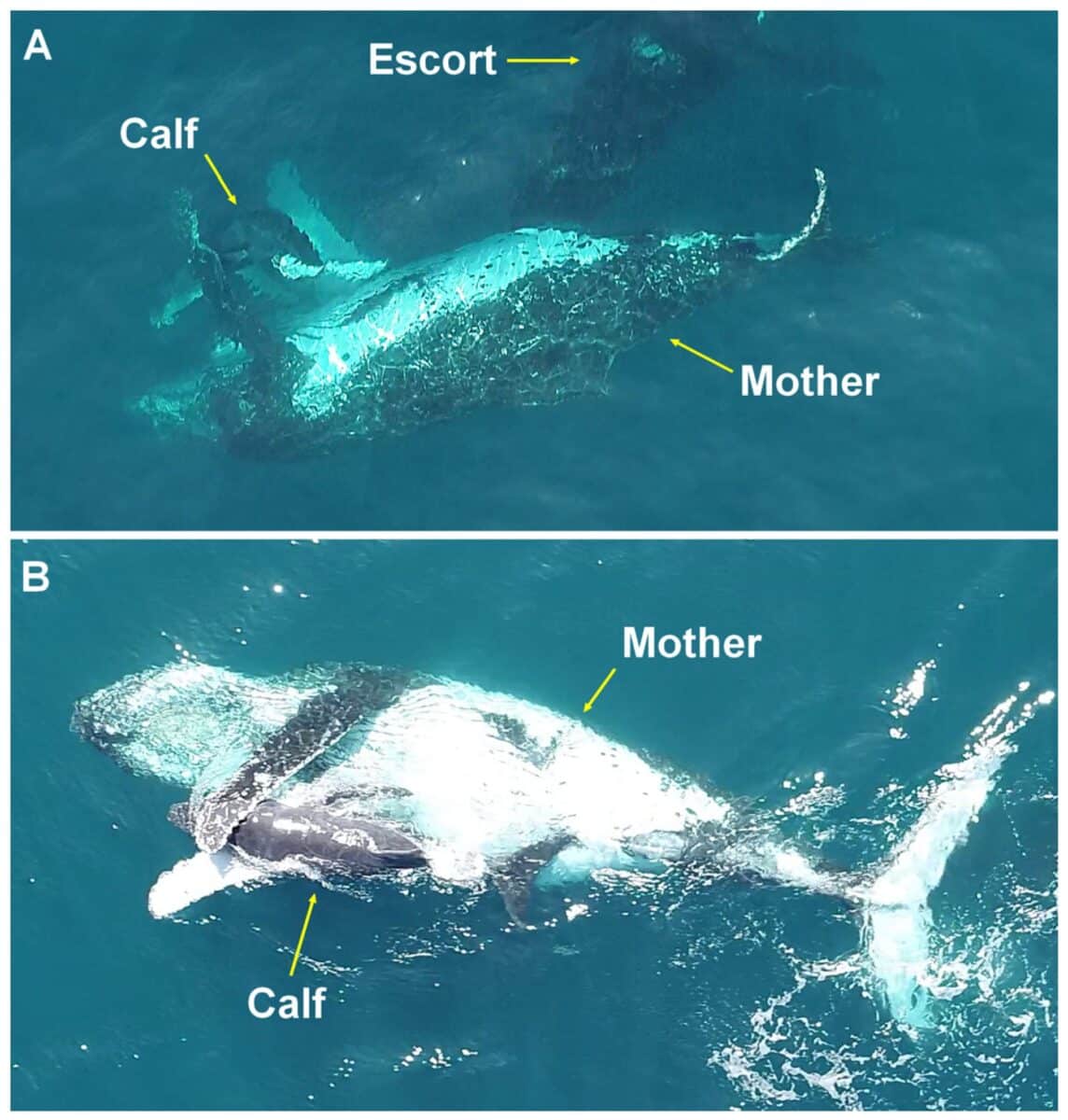
The presence of multiple whales at birth is due to social structure and cooperation. Some scientists have suggested that these individuals may be related to their mothers, while others may simply be part of temporary groups formed during migration or reproduction.
Such behavior may also have multiple purposes. Getting close may also deter predators, help newborn whales, and provide learning opportunities for young whales. However, without long-term follow-up and additional observations, these interpretations remain tentative.
#Scientists #film #rare #moment #whale #birth #nearby #whales #mother