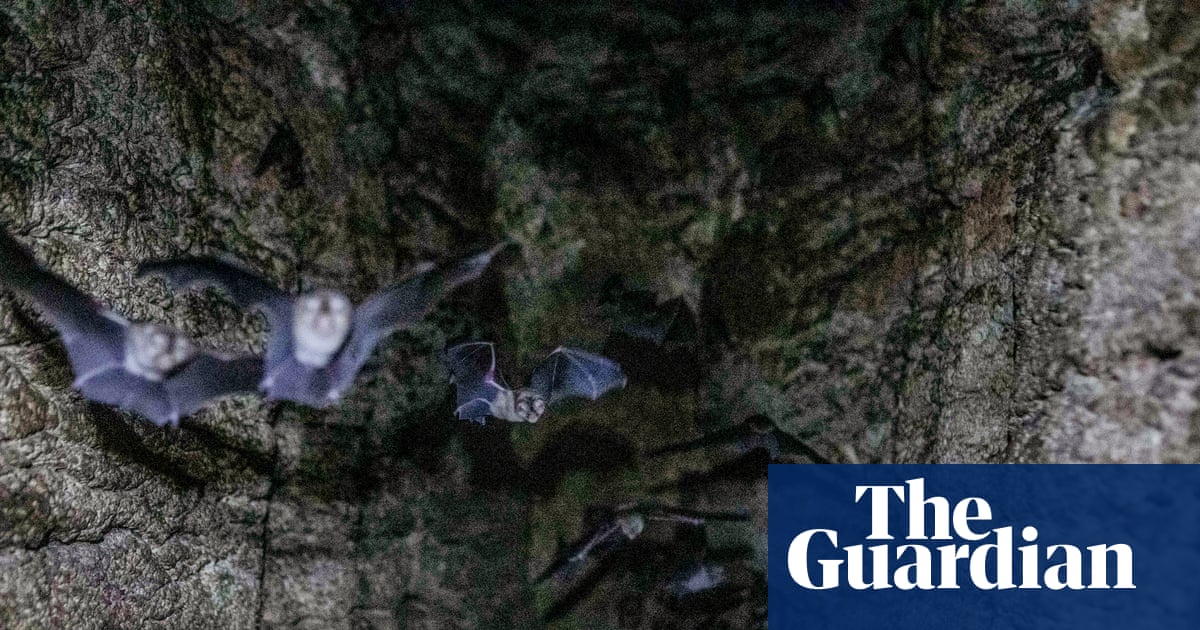
aRaúl da Silva Armando Chomera waits for his eyes to adjust after carefully wriggling into a cool, damp cave. A molecular biologist in the Mozambican port city of Beira wears latex gloves, a helmet with a headlamp, and a mask that protects his lungs from particles and bacteria as he stares into shadowy hollows for signs of bats.
He spent two years in these claustrophobic spaces studying winged mammals and their excrement. “Guano is more than just bat poop,” he says. “If I were to describe it in one word, I would say ‘ecosystem.'”
Guano, produced over time from the feces of birds and bats, is an abundant and powerful organic substance that is home to cave-dwelling beetles, frogs, and salamanders.
Caves are little worlds unto themselves. They all smell, look, and feel different due to organisms and microbiomes that have evolved to exist in very niche conditions without sunlight.
It’s just one of more than 30 caves in and around Gorongosa, a vast 4,000 square kilometer (1,500 square mile) national park in central Mozambique and one of Africa’s most biodiverse regions.
Chomela’s work is not for the faint of heart. He regularly forces his way into small, dark spaces, or climbs down ladders and ropes to find himself in unknown environments with strange inhabitants. There’s always a chance you’ll get stuck.
According to the park’s science department, these underground honeycomb networks span 183 square kilometers. There is no data on how many of the more than 100 bat species found in Gorongosa live here, but Tombo Afale 5, which is the site of active archaeological excavations and is one of the most studied caves, is home to more than 10,000 bats, Chomela said.
Gorongosa was founded in 1960 by the colonial Portuguese government. However, biodiversity and conservation were not priorities for the Marxist-leaning Frelimo Party (Mozambique Liberation Front) came to power in 1975 after a 10-year war of independence.
Just two years later, the park became the battlefield of a bloody civil war waged by Renamo’s guerrilla forces (Mozambican national resistance movement), established by the white minority government led by Ian Smith in Rhodesia and later supported by apartheid South Africa.
Renamo guerrillas found shelter and fuel in the bush, hunting and consuming whatever they could get their hands on: elephants, buffalo, waterbucks, hippos, and even southern pouch rats. By the time the war ended more than 15 years later, 95 percent of the region’s wildlife, including nearly all of the region’s 5,500 hippos, had become extinct, and many feared the animal kingdom would never fully recover.
The immense trauma inflicted on the local people, survivors of the protracted war, who suffered forced conscription and human rights violations from both sides, is still recognized in the identities of modern generations.
Despite these challenges, decades of careful environmental efforts, often led by international organizations but also increasingly involving Mozambican researchers and communities, have resulted in one of the most satisfying stories of environmental success in Africa.
These include the Paleoprimate Project (PPP), a partnership launched in 2018 between the University of Oxford and Gorongosa National Park, led by primatologist and paleoanthropologist Susana Carvalho.
The project brings together national and international researchers and students in archaeology, ecology and geology. “[Gorongosa Restoration Project] is the region’s largest employer and is an important factor in economic stability,” Carvalho said.
Chomera started his work in Gorongosa in 2022 as a researcher in the Biodiversity Laboratory and joined PPP in 2025. His interests range from using environmental DNA to reconstruct the ancient history of parks to metabarcoding, a cutting-edge molecular technique for determining the species composition of primate and bat DNA samples. A first-year PhD student at the University of Porto in Portugal, his research is based at the EO Wilson Institute in Chitengo, central Gorongosa, where he heads the genetics lab.
Chomera, 28, is at the forefront of some very niche fields that revolve around the impact of economic activity and climate change on Gorongosa’s ecosystem, including the role of bats.
“We know that bats feed on insects such as malaria-carrying mosquitoes and pests that protect crops,” Chomela said. “Therefore, we are focused on understanding exactly what constitutes the bats’ diet and the rate at which they produce guano.”
Many locals, especially young men, know these caves like the back of their hands, having grown up playing in them before harvesting guano for a living. After his father passed away last year, João Lorenzo Daose, 29, became a community leader in Inaminga, a town near the cave, and serves as a cave guide for PPP members. “He knows the easiest and safest way to get to most caves,” Chomera says.
The two have developed a strong relationship, and Daos has begun sharing new perspectives on bats and the benefits they bring to farmers with his neighbors.
Mozambicans are among the poorest people in the world. This southern African country ranks on the United Nations’ Human Development Index despite being rich in diamonds, rubies, graphite, gas, and other natural resources. Harvesting guano is one of the few reliable ways to earn cash in rural areas.
Chomela estimates that on average, harvesters earn 200 meticais (2.33 pounds) for every 50 kg of nitrogen, phosphorus and potassium-rich guano, which is collected and sold as agricultural fertilizer for mainly sorghum, beans and corn. “Local residents know that guano is a very good fertilizer and add it to their home fertilizers. Machamba [farming plots]” says Chomera.
However, without a planned collection system, guano can be rapidly depleted, damaging cave biodiversity and local community income.
“When they see guano, they see money. But guano is what ensures stable environmental conditions inside the cave, from 100% humidity and 50 degrees Celsius. [122F] “This is the temperature that some bats need to survive. Overharvesting can damage the structure of the cave and make it sterile,” Chomela said. The Harvester then moves on to the next cave.
“We want the scientific evidence to convince local communities, and society in general, of a sustainable way to harvest guano that doesn’t disturb bats too much and uses less damaging techniques,” he says.
To attach metabarcodes, Chomera captures bats, tags them, and then holds them in sterile bags until they produce feces. These samples provide a wealth of information, including what bats eat, sex ratios, and the presence of parasites and pathogens.
He hopes the results of the bat guano DNA research he is working on with two other researchers will help people living in these remote areas become bat guardians themselves. “For example, if we could prove that bats feed on pests that plague farmers’ crops, [farmers] “They’ll be more friendly to bats,” he says.
Humans have always coexisted with bats, but our understanding of their role in the ecosystem is limited. Traditional beliefs often consider them to be bad omens or falsely attribute them to illness. “Some people believe that if a bat comes into their house, someone will die,” Chomela said. “It is important to show that this is not the case.
By presenting scientifically backed evidence to local residents, they hope to convince local residents, who are the guardians of the caves, of the importance of coexistence.
#Guano #poop #Scientists #uncover #secrets #Gorongosa #Parks #bat #poop