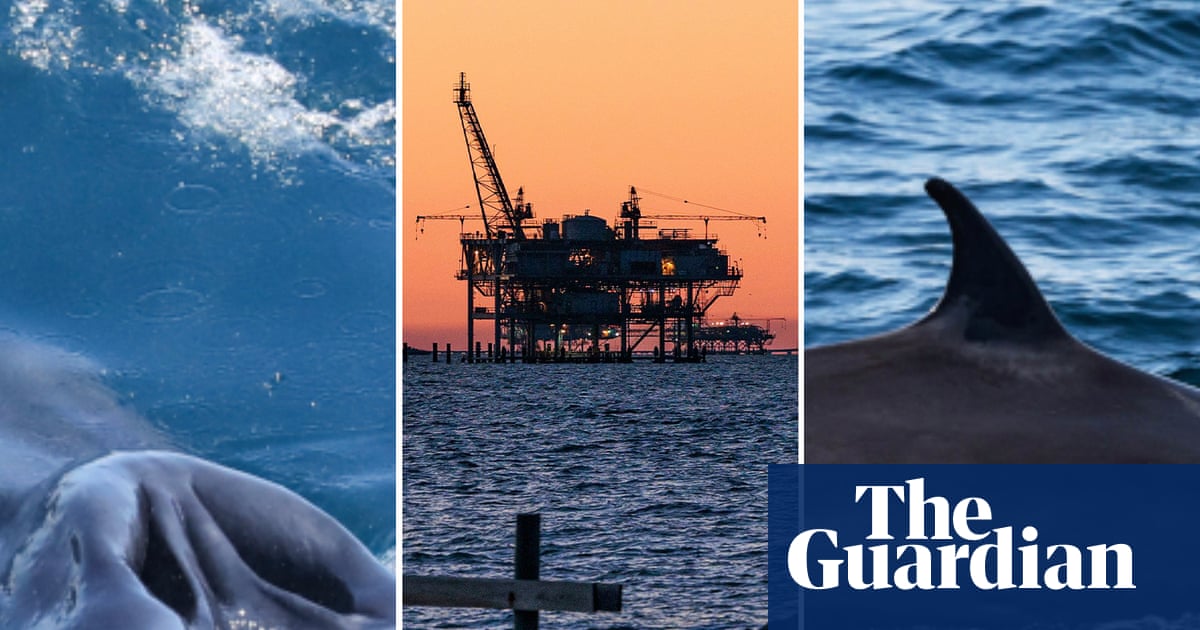
SEven before modern humans existed, rice whales grew to leviathan-like sizes while diving deep to devour fatty fish, growing to the length of a bus and weighing as much as six elephants.
Unfortunately for these giant creatures, their only habitat became a part of the Gulf of Mexico that much later the oil and gas industry became very interested in drilling for. There are only about 50 of these baleen whales left on Earth, surrounded by rattling boat roads and changing drilling infrastructure.
Unbeknownst to the cetaceans, an existential crisis arrived last week when the Trump administration made the extraordinary decision to eliminate all protections for rice whales, along with other endangered marine life in the Gulf, due to an industry that has helped overheat the ocean and atmosphere. This could lead to the extinction of a whale species in North American waters for the first time in 300 years.
“Nothing in this administration surprises me, but if I’m still capable of shocking, this is it,” said Pat Parenteau, an environmental law expert at Vermont Law School.
“‘Unprecedented’ is too mild a word. It’s unbelievable. Donald Trump likes to be first, and if this is upheld he will be the first president to make a conscious decision to exterminate whales. It will happen before our eyes. What a stain on our legacy it will be.”
In a closed-door meeting that lasted just 15 minutes at the Interior Department on Tuesday, six Trump administration officials agreed to exempt the oil and gas industry from complying with the Endangered Species Act in the Gulf of Mexico.
The commission was formed under an unusual conglomeration called the Endangered Species Commission, and is more informally referred to as “God’s Squad” because it essentially has the power to decide whether a species lives or dies. The event has only been held three times and hasn’t been held since 1992, when Oregon allowed logging in northern spotted owl habitat.
Complaints from states and businesses typically begin a lengthy review before a God Squad hearing. But in this case, the fate of imperiled whales, sea turtles, and other at-risk species rests in the hands of Secretary of Defense Pete Hegseth, who invoked “national security” for the exemption, the first such rationale offered since the passage of the Endangered Species Act in 1973.
“If development in the Gulf region slows, we will not be able to produce the energy we need as a country,” Hegseth said at the meeting. “Recent hostilities by Iran’s terrorist regime underscore once again why robust domestic oil production is a national security imperative.”
The United States is one of the world’s largest oil and gas producers, and the Endangered Species Act, which prevents harassment or harm to endangered species, has never stopped drilling projects in the Gulf. In any case, Secretary of the Interior Doug Burgum said, “We must not disrupt the flow of energy in the American Gulf or be held hostage by ongoing litigation.”
In practice, this means that rice whales, listed as endangered in the U.S. and endangered internationally, will be stripped of modest protections that oil and gas companies are required to follow, such as slowing boats in whale habitat and monitoring the creatures during exploration and drilling operations.
The only whale that spends almost all of its time in U.S. waters, the major threats to rice whales all stem from the oil and gas industry. Ship traffic is congested in the northern Gulf of Mexico, and there have been cases of ships attacking and fatally injuring whales resting on the surface at night. Noise from seismic surveys, pipelines, cables, and drilling also interfere with whale communication vocalizations, including long moans.
Meanwhile, the devastating Deepwater Horizon oil spill in 2010 killed about one-fifth of all known rice whales. “Our industry has a long track record of protecting wildlife while developing ocean energy responsibly,” argued Andrea Woods, a spokeswoman for the American Petroleum Institute, whose membership includes BP, the company responsible for the deep-sea disaster.
The oil and gas industry has welcomed the move, even though it is not calling for the removal of endangered species. “Long term, it will be up to U.S. energy leaders to get the balance right while meeting growing energy demands through reasonable, science-based protections,” Woods added.
Rice whale (Balaenoptera rice), named after the late cetacean researcher Dale Rice, were first considered a separate species in 2021 after federal scientists noticed that they differ from the similar Bryde’s whale (the two species differ both genetically and in the shape of their large skulls).
It quickly became clear that the rice whale was in a precarious position. This whale is rare and confined to narrow and crowded parts of the bay. As Jeremy Kiszka, a biologist and marine mammal expert at Florida International University, puts it, the fish are also “bougie eaters,” preferring to eat only fatty fish found hundreds of meters deep.
“There are a lot of factors that make this species really vulnerable,” Kiszka said. “It’s a borderline species. The more we drill and the more we industrialize the Gulf, the more likely we are to lose species that are found only or primarily in U.S. waters. We can still save these animals, but the situation is dire.”
The idea that a whale species could become completely extinct may seem anachronistic. No cetacean species has been lost near the continent since the North Atlantic gray whale population went extinct in the 1700s. Since the 1980s, when whaling was abolished, the world’s whale population has rebounded significantly. “Ceasing commercial whaling is one of the greatest conservation successes on earth,” Kiska said.
Still, many cetaceans, including dolphins and porpoises, are under threat from global warming, ocean pollution, and drifting fishing gear, with just a few vaquita porpoises left in the Gulf of California and 384 remaining North Atlantic right whales stranded in fishing lines and nets.
But rice whales are probably the most at risk of all species, Kiska said. “They can’t go anywhere, there’s nowhere else,” he said. “You never know what you’re going to lose until it’s gone. I really don’t want to think that these animals are going to be gone anytime soon, because if you do that, you’re already grieving.”
President Trump previously spoke of his distress over a dead whale that washed up on the shore, which he falsely blamed on an offshore wind turbine he was trying to shut down. “Windmills are driving the whales crazy,” the president said, even though scientists have pointed to other factors as the main threat to whales.
Kujira has another ostensible ally in the cabinet. U.S. Secretary of Health Robert F. Kennedy Jr. previously advocated for whales as an environmental lawyer, and 20 years ago saw off the head of a dead beached whale and tied it to the roof of his car. Like Trump, Kennedy has argued that offshore wind turbines harm whales.
The National Marine Fisheries Service, which is responsible for managing the U.S. oceans, did not respond to a question about whether it currently believes wind turbines are a greater threat to whales than oil drilling, but a spokesperson said the commission “recognized the significant risks associated with restricting oil and gas activity in the U.S. Gulf and voted in favor of a national security exemption.” [Trump’s preferred name for the area of sea]”.
A number of environmental groups are suing to overturn the God Squad ruling, arguing that it is illegal. “You can’t just wave the national security wand and decide to wipe something out without any process,” Parenteau said. “I don’t think the courts will take over. If they did, national security could be used to justify everything from timber sales to new data centers for AI to increased drilling.”
“This all shows how dependent they are on fossil fuels, even if it doesn’t make sense,” he added of the administration. “They’re fossil junkies.”
If the decision survives legal challenges and the gray whale population dwindles to extinction after its long stay on Earth, it would mean the government “voted to deliberately eradicate an entire species of whale from the face of the earth,” said Dan Snyder, director of the Environmental Enforcement Project.
“So what’s the benefit? Our children will ask. To help the big oil and gas tanker ships sail a little faster.”
#Rice #whales #older #modern #humans #Trump #exterminate