When the peacock mantis shrimp collide, it generates star heat. The crustacean retracts and latches its spring-loaded mouthparts, known as dactyl crabs, like a cowboy holding the hammer of a gun.
When you pull the trigger and release the stored elastic potential energy, the club moves like a bullet, reaching speeds of up to 31 meters per second (approximately 111 kilometers per hour).
The speed of the punch is so high that the surrounding pressure drops and the water boils, forming a steam-filled bubble that suddenly collapses due to “cavitation.” That’s the sound of pops, flashes of light, and temperatures approaching 5,000 degrees Celsius, as hot as the surface of the sun.
“The cavitation bubble collapses, creating a violent burst of energy,” explains biologist Sheila Patek of Duke University in North Carolina.
Bubbles around a boat’s propeller can damage metal, but the “smasher” species of mantis shrimp uses this force (more than 100 times their body weight) to crack open snails and other packaged foods.
“They evolved a mechanical system of hammers and spring latches to crush hard-shelled prey with high accelerations,” says Patek, whose research focuses on fast, forceful movements in animals. “It can produce up to 1,500 newtons (N) upon impact.”
The peacock mantis punch holds the record for fastest attack in the aquatic world, but on land the title of fastest gun in the West goes to Dracula Ant.
The ant’s mandibles can close in 23 microseconds (more than 4,300 times faster than the blink of an eye) at 90 meters per second (321 km/h), allowing the vampire to bite into the insect’s exoskeleton and drink its blood. But while these tiny jaws are certainly impressive, they don’t scare away larger creatures.
Are teeth a weapon?
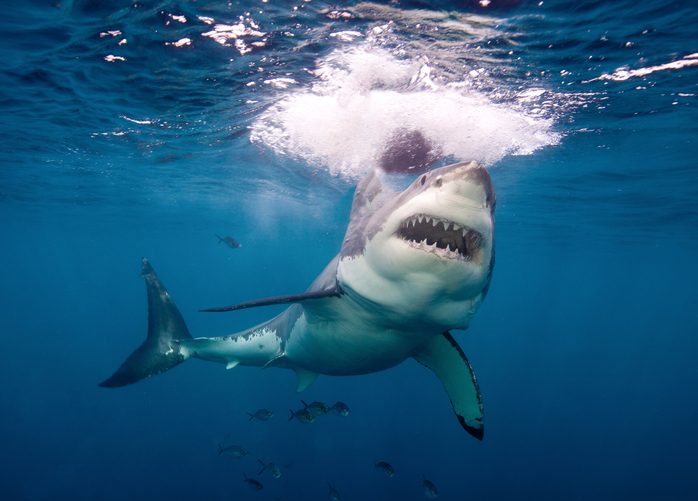
Perhaps nature’s most terrifying weapon is the great white shark’s jaw. Scientists predict from computer models that its bite force reaches 18,216N, the highest estimate of any extant species (the highest ever measured was 16,414N in the saltwater crocodile).
Each large white tooth is triangular in shape, concentrating the force on a small surface area so the predator doesn’t have to press hard to impale its prey.
Although shark and human teeth are made of slightly different materials, they are similar in hardness and strength, enough to withstand great forces.
So why do great white sharks keep growing new teeth?
“We don’t know how many times each tooth is bitten or how often most sharks lose their teeth, but it’s never broken,” says Lisa Whitenack, a biologist at Allegheny College in Pennsylvania who earned her PhD on the biomechanics and evolution of shark teeth.
Instead, great white sharks may need to replace their teeth periodically as they become dull and lose their sharp edges.
“After just 10 to 20 bites, a shark’s teeth can become significantly dull.”
The serrated structure of the large white teeth also helps tear meat. When a predator tightens its body, it shakes its head and makes a sawing motion.
“A butter knife doesn’t catch as many fibers in the meat, but a steak knife has heavier serrations that can catch fibers,” says Whitenack. “The harder you push, the less force you’ll need to pull and cut the steak.”
What can be classified as a weapon?
Features such as the great white shark’s jaw and the mantis shrimp’s club have evolved over millions of years into shapes that appear to be perfectly adapted to their functions.
These are consistent with the Oxford English Dictionary’s definition of the word “weapon”. “Any kind of instrument used in war or combat to attack and overcome the enemy.”
However, such physical devices do not qualify as weapons based on biology’s traditional definition of “prominent morphological structures used by males in competition for access to females.”
Well-known examples include deer antlers and beetle antlers. But defining weapons so strictly is problematic.
For example, characteristics unique to females, such as the stingers of hornets, wasps, and ants, which evolved from ovipositors once used to lay eggs, are ignored. More importantly, focusing on prominent male structures may overlook the weapons of non-animal creatures.
In the plant kingdom, carnivorous species such as Venus flytraps can capture small arthropods. But some scientists would argue that the plant’s jaws are nothing more than mechanical bear traps, not combat weapons.
Similarly, barbed structures such as thorns, thorns, and thorns are similar to barbed wire and are known as plants’ defenses against herbivores, as they evolved to deter herbivores.
However, despite the fact that flowering plants cannot move or attack, this group has some clear examples of men using traditional weapons.
In milkweed, male pollen is contained in a sac that attaches to insects when the pollinator visits the female part of another flower.
A 2014 study showed that some species have horned pouches to prevent other males’ pouches from attaching to them. This is similar to how dominant male mammals, such as large-tusked walruses, occupy prime coastal areas and monopolize mating opportunities.
“Our study demonstrates for the first time that plants can engage in physical combat between males,” said Andrea Cocci, director of the Botanical Museum of the National University of Córdoba in Argentina.
How did animal weapons evolve?
Weapons evolved through natural selection because they enabled the ancestors of species to survive and reproduce.
This survival of the fittest can be caused by “ecological selection” where changes in the environment (such as prey availability) favor individuals with beneficial adaptations such as claws or claws.
However, traits used in competition between males, such as the microscopic horns of milkweed pollen, the majestic antlers of stags, and the mandibles of stag beetles, are typically selected by females.
Such structures require energy to grow, are cumbersome to transport, and are noticeable to predators. This means that they exist because the potential costs to survival are greater than the benefits to reproductive success.
This is the theory of sexual selection first proposed by Charles Darwin.
“Darwin’s seminal work explained the widespread presence of horns in vertebrates and insects as an evolutionary product of sexual selection,” Kocucci says. “Once the male has won the battle, he can access the female for reproduction.”
Does chemical warfare exist in the animal kingdom?
Habitats are also battlefields where organisms wage chemical warfare. However, some species produce chemical toxins that cause disease and death, and these toxins have evolved primarily as deterrents.
They make the organism uncomfortable and passively enter the body. In contrast, if a toxin is actively delivered by injection, bite, sting, or spray, it is a venom, a weapon for attack or self-defense.
“Predatory venoms usually act by quickly immobilizing prey, while defensive venoms generally cause rapid pain to deter attackers,” says Ronald Jenner of the Comparative Toxicology Group at the Natural History Museum in London. Venom: The secret of nature’s deadliest weapon.
However, while many poisons are not designed to kill people, the end result is often death. Its destructive effects range from preventing blood clotting causing internal bleeding to behavioral manipulation and liquefaction of the host.
A poison can be a mixture of multiple toxins, each affecting specific molecules in the intended victim. However, these molecules can vary between species, so a particular poison may be harmful in one species but harmless in another. That makes it difficult to determine which is the worst, Jenner says.
“The effects of poisons are diverse and no single measure of their power can be captured.”
Nevertheless, scientists often study potency through a metric called the LD50, the lethal dose that kills 50 percent of a population of laboratory mice, as a model for how a poison affects another mammal, humans.
But LD50 also shows why the worst venoms are difficult to identify, as shown by the Brazilian frog, which uses its head as a weapon. The venom of the Brunocasku head frog is 25 times more lethal than the venom of the Bothropus pit viper, while the snake’s fangs are more dangerous because they release more venom in a single bite.
One of the most lethal delivery methods belongs to cone snails, whose weapons are usually a mixture of 100 to 200 ingredients.
Like many molluscs, snails have a tongue-like organ known as the radula, which is covered with small teeth (denticles) and is used to scrape and lick the surface of food.
In fish-hunting cone snails that live in tropical coral reefs, this organ is partially modified into a radula, a harpoon that is fired from the snail’s proboscis to pierce the skin of its prey before injecting a chemical called a conotoxin with a hypodermic needle.
The backward-pointing barbs of the harpoon hold the fish in place, and the slow-moving mollusk reels in the prey. This is the “taser and tether” strategy.
“The fish becomes immobile within seconds,” says Baldomero Olivera, a neurobiologist and conotoxin expert at the University of Utah.
“The snail simply retracts its proboscis, and the paralyzed fish is swallowed. The snail then regurgitates the scales, bones, and harpoon, and the soft parts go into its intestines to be digested.”
Snails that live on the muddy or sandy ocean floor are at risk and employ a different strategy: hunting as ambush predators. They use their prongs as piercing and throwing spears, and rely primarily on scent to track prey.
The deadliest species for humans is the cone snail, which kills dozens of people thanks to its 70 percent mortality rate (without treatment). The conotoxin has a variety of effects on the victim’s nervous system, including disorientation and drowsiness, convulsions and coma.
“After about 30 minutes, the fish won’t move,” Baldomero said. “Eventually, when the fish freezes and cannot move, the snail approaches the fish, swallows it, and quickly hides.
What about psychological weapons?
Next to physical and chemical abilities, there is another type of weapon. It’s a mental ability. Although most living things are limited to body parts inherited through biological evolution, the mind can come up with new techniques and strategies during a lifetime and pass them on to the next generation through culture.
The most effective tool of the mind is the human mind, which has enabled us to do everything from inventing agricultural methods that turn prey into livestock to building nuclear bombs and other weapons of mass destruction.
However, we are not the only animals that use our minds. Chimpanzees use military tactics such as carving spears from branches and climbing to high ground to scout for enemies.
Leaving a dead body as an act of terrorism, in other words, psychological warfare.
Obviously, evolution has created a set of capabilities for fighting and killing. Things like the heart are hidden. You can also see the bright bubbles created by the giant mantis shrimp.
They all emphasize the diversity of life, which Darwin described as “the most beautiful infinite forms.” But as nature’s greatest weapon reveals, even beauty can be cruel.
#Effects #range #internal #bleeding #behavioral #manipulation #liquefaction #host #animal #kingdoms #deadliest #weapons #Discover #Wild #Animals